

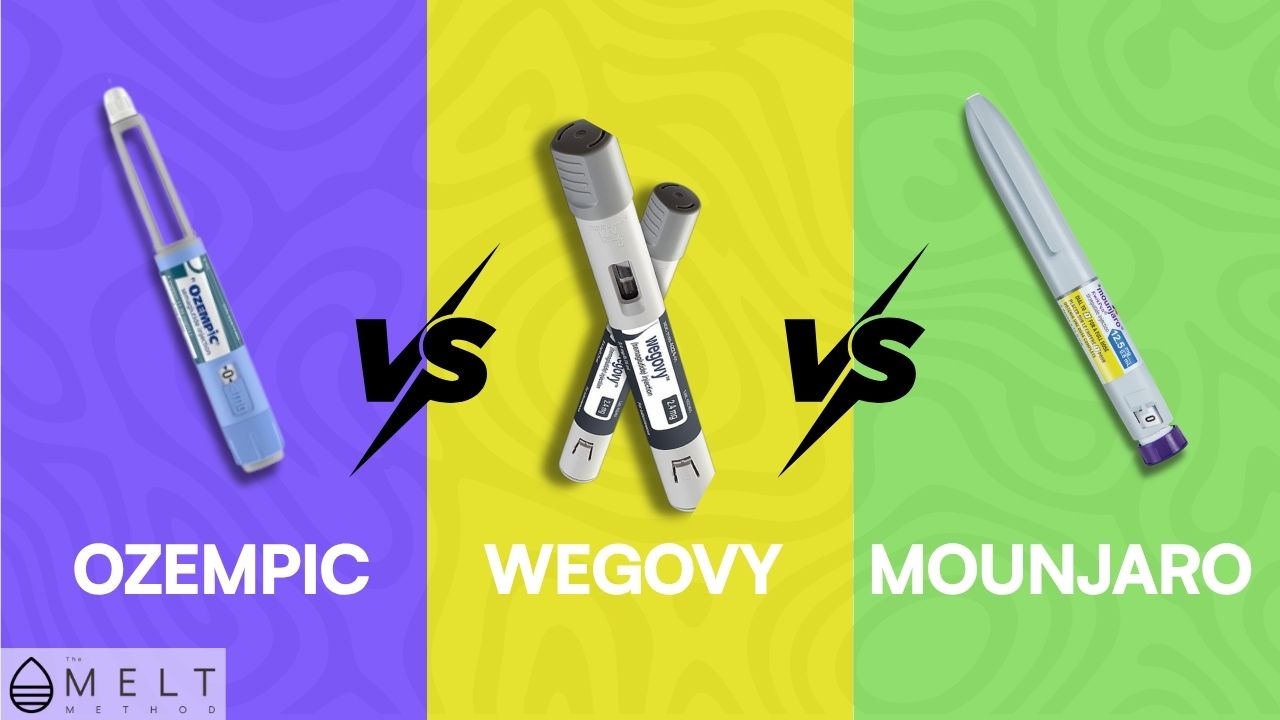
Okay, so you’ve been hearing these names everywhere. Your coworker is on Ozempic. Your neighbour mentioned Mounjaro. And Wegovy keeps popping up in news headlines. But nobody’s really explaining what makes them different or which one might actually make sense for you.
I get it. As a clinician working with Canadian patients on weight management in a weight loss clinic, this is probably the question I get asked the most. So let me just… answer it. Clearly, without the jargon, and without the hype.
First — What Are These Drugs, Actually?
Let’s clear something up right away because this trips a lot of people up.
Ozempic and Wegovy are the same drug. Both contain semaglutide, made by Novo Nordisk. The difference is the dose and what they were approved for. Ozempic came first, approved for type 2 diabetes management. Wegovy is essentially the same molecule at a higher dose, approved specifically for chronic weight management.
Mounjaro is different. Its active ingredient is tirzepatide, made by Eli Lilly. It works on two hormonal pathways instead of one — and that distinction matters more than you might think.
So when people debate Ozempic vs Wegovy vs Mounjaro, they’re really comparing two variations of semaglutide against a newer, dual-action drug. That’s the foundation of everything else in this guide.
How Do They Actually Work in Your Body?
All three belong to a class of medications called GLP-1 receptor agonists. GLP-1 is a hormone your gut naturally produces after eating — it signals your brain that you’re full, slows down how fast your stomach empties, and helps regulate blood sugar.
These medications mimic that hormone, but in a stronger, more sustained way than your body does naturally. A lot of patients describe the effect as the “food noise” going quiet — that constant mental background hum of thinking about food, craving snacks, planning your next meal? It just… settles down. A lot.
Now here’s where Mounjaro does something different: tirzepatide activates both GLP-1 and GIP receptors. GIP is another gut hormone involved in fat metabolism and energy storage. Because tirzepatide mimics two hormones while semaglutide mimics one, it hits two appetite-regulating pathways simultaneously WebMD — which is a big part of why the weight loss numbers tend to be stronger with Mounjaro.
Ozempic vs Wegovy vs Mounjaro: The Real Differences
1. Weight Loss Results
This is what most people actually want to know.
When it comes to Mounjaro vs Ozempic weight loss results, the data is pretty clear. Ozempic produces around 5–10% body weight loss as a secondary benefit, Wegovy achieves an average of 15% weight loss over 68 weeks in clinical trials, and Mounjaro has shown up to 22.5% weight loss with its dual mechanism.
And if you’re wondering how much weight you can lose on Mounjaro vs Ozempic, the gap is significant. In the Phase 3b SURMOUNT-5 trial published in the New England Journal of Medicine in May 2025, researchers found tirzepatide achieved roughly 20% weight loss compared to about 14% for semaglutide at 72 weeks.
That said, these are averages. Some patients respond incredibly well to Ozempic. Others plateau on Wegovy and do much better switching to Mounjaro. Biology is individual. The numbers are a starting point, not a promise.
2. Dosage and Approvals (What’s What in Canada)
This is where it gets a bit tangled for Canadian patients, so I’ll be straight with you.
Ozempic is approved in Canada for type 2 diabetes. It gets prescribed off-label for weight loss all the time, that’s legal and common but insurance coverage gets complicated fast.
Wegovy is approved in Canada specifically for chronic weight management in adults with obesity, or those who are overweight with at least one related health condition. It’s the same molecule as Ozempic, just at a higher maximum dose.
Mounjaro is approved in Canada for type 2 diabetes. The weight-loss branded version, Zepbound, is approved in the US but as of early 2026 the regulatory landscape in Canada for weight management is still evolving. Some physicians prescribe Mounjaro off-label for weight loss here.
This stuff genuinely changes. If you’re not sure what’s currently available or covered, that’s exactly the conversation to have in a proper medical consultation, not a quick Google.
3. Side Effects: Ozempic vs Mounjaro vs Wegovy
When comparing Ozempic vs Mounjaro side effects, the profiles are similar across all three because they all work on the same basic mechanism. The most common ones are nausea, vomiting, constipation, diarrhea, fatigue, and acid reflux. Especially in the early weeks as your dose ramps up.
Most people find these manageable, and they do tend to get better over time. Starting at a low dose and titrating slowly, which is standard practice. It makes a significant difference in how well patients tolerate these medications.
Mounjaro’s dual mechanism may increase nausea and vomiting during the first 4 to 8 weeks of treatment, slightly more pronounced than semaglutide-based options. That said, some patients who switched from Ozempic to Mounjaro actually reported less vomiting and nausea on tirzepatide. Although, everyone’s different.
The rarer but more serious risks: pancreatitis, gallbladder issues, thyroid concerns. These are real but uncommon, and exactly why these medications need to be prescribed and properly monitored by a physician. Not sourced from a wellness spa. Not a quick telehealth script with zero follow-up.
4. Ozempic vs Wegovy for Non-Diabetics
This is one of the most common questions I get. If you don’t have type 2 diabetes, which medication makes sense?
When it comes to ozempic vs Wegovy for non-diabetics, Wegovy is typically the first consideration. It’s the version that’s actually approved for weight management in non-diabetic patients, and it gives physicians more flexibility at higher doses. Ozempic was designed around diabetes care, so the dosing schedule isn’t as optimized for weight loss purposes.
Mounjaro is another strong option for non-diabetics, particularly those who are looking for how to lose weight or have underlying metabolic issues. The SURMOUNT-5 trial specifically studied adults without type 2 diabetes, directly comparing tirzepatide to semaglutide, so the evidence base for non-diabetic use is solid and growing.
5. Cost and Availability in Canada
I want to be honest here because this is genuinely frustrating for a lot of patients.
Ozempic is generally the most accessible, it’s been around longest, has broader pharmacy availability, and private insurance sometimes covers it for diabetes. Wegovy has had real supply inconsistencies in Canada, and public coverage through programs like OHIP is limited for weight loss purposes. Mounjaro is similarly variable.
Out-of-pocket costs for these medications can range anywhere from $200 to $500+ per month depending on the dose, a real barrier for many people. The coverage landscape is shifting, and advocates are actively pushing for better access. If cost is a concern, that’s a conversation worth having with your prescribing physician as manufacturer savings programs do exist.
So Which One Is Right for You?
Honestly? I can’t tell you without knowing you. And if someone tells you otherwise without a proper intake, that’s a red flag.
Here’s a rough framework I use with patients:
- Ozempic makes the most sense if you have type 2 diabetes, have insurance coverage for that indication, and are looking for a well-studied starting point.
- Wegovy is usually the first consideration for non-diabetic patients whose main goal is weight management and who need a higher-dose semaglutide option.
- Mounjaro comes up when patients need more meaningful weight loss outcomes, have insulin resistance, or haven’t responded as strongly as expected to semaglutide.
Switching between medications happens. It’s not a failure, it’s just medicine working the way medicine works.
The Thing Nobody Talks About Enough
These medications are genuinely effective. The clinical data is real, and for many patients they’ve been life-changing. But they’re tools, not the whole answer.
Earlier clinical trials showed that patients who stopped semaglutide or tirzepatide regained more than half the weight they lost within a year, though more recent real-world data suggests that patients who restart, switch medications, or adopt meaningful lifestyle changes fare considerably better.
That’s the key point. Patients who combine medication with exercise support, nutrition guidance, and work on the psychological side of eating tend to do significantly better, more weight lost, longer sustained results, and an overall healthier relationship with food. Medication quiets the appetite signal. It doesn’t rewire 20 years of stress eating habits or build movement into your daily life.
That gap is exactly what integrated care is designed to fill.
Getting Started in Canada
If you’re a Canadian, living in Ontario, considering any of these medications, the first step is a proper conversation with a physician who specialises in weight management. At The MELT Method, we start every patient with a free assessment and connects you to an accredited, licensed weight loss physicians in Ontario with a OHIP-covered weight loss program. We look at your full picture, history, goals, what medications might make sense, and what support you’ll need alongside them.
Because the medication is one piece. We want to make sure you have the rest.
Frequently Asked Questions
Is Mounjaro better than Ozempic for weight loss?
In most cases, yes, and the clinical data backs this up pretty clearly. Mounjaro tends to produce stronger weight loss results than Ozempic, largely because it works on two hormonal pathways instead of one. That said, “better on paper” doesn’t always mean “better for you.” Some people respond really well to Ozempic and never need to switch. Others hit a wall and do much better on Mounjaro. It genuinely depends on your biology, your dose, and what else is going on with your health. This is exactly why cookie-cutter prescribing doesn’t work, the medication that’s “best” is the one that works for your body, with proper support around it.
Can I take Ozempic or Wegovy if I don’t have diabetes?
Yes, you can, though the details matter. Wegovy is actually designed for non-diabetic patients. It’s approved specifically for weight management in adults with obesity, or those who are overweight with at least one related health condition. Ozempic is a different story, it’s technically a diabetes drug, so using it for weight loss means going off-label, which is legal and common, but it does complicate insurance coverage. If you don’t have diabetes and weight loss is your primary goal, Wegovy is usually the more straightforward starting point.
Will I gain all the weight back if I stop taking these medications?
This is probably the question I get asked most, and I want to give you an honest answer rather than a reassuring one. Earlier clinical trials did show pretty significant weight regain after stopping, we’re talking more than half the weight lost, within about a year. More recent real-world data paints a slightly more hopeful picture, particularly for patients who restart treatment, switch to another medication, or have genuinely built lifestyle habits alongside the drug. But here’s the truth: if the medication was doing all the heavy lifting and nothing else changed, stopping it is going to be hard. That’s not a moral failing, it’s just biology. It’s also exactly why we don’t prescribe medication in isolation.
Can I switch from Ozempic to Mounjaro?
Yes, and it happens more often than you might think. Some patients don’t get the results they were hoping for on Ozempic, others want to try the stronger option, and some actually find the switch helps with side effects, particularly nausea. A few patients who struggled with vomiting on Ozempic have told me they tolerated Mounjaro much better. Your doctor will walk you through the timing of the switch and how to do it safely. It’s not a big deal, it’s just adjusting the approach.
Are these medications actually safe to take long-term?
The honest answer is: the evidence is growing and, for most patients, it’s reassuring. These are relatively newer medications in the context of long-term data, but what we do have looks positive for the majority of people. There are rare but real risks, pancreatitis, gallbladder problems, thyroid concerns in people with certain genetic conditions and those need to be monitored. Which is why “I got it online without a consultation” is a genuinely bad idea. If you want to dig into the clinical side of things, the SURMOUNT-5 trial in the New England Journal of Medicine is the best head-to-head data we have right now, and drugs.com has a solid breakdown if you want something more digestible.
How do I actually figure out which one is right for me?
You talk to a doctor who knows what they’re doing in weight management. Not social media. Not your friend who lost 30 pounds and swears by one of them. Not a telehealth platform that asks three questions and sends a prescription. A real consultation that looks at your health history, your metabolic profile, your goals, what’s available and covered in Canada right now, and what support you’ll need around the medication. That’s the only way to answer this question properly. If you’re in Canada and want to start that conversation, our free assessment at The MELT Method is a good first step and the initial consultation is OHIP-covered.
This article is for informational purposes only and does not constitute medical advice. Please speak with a qualified healthcare provider before starting or changing any medication.