

Weight Loss With Type 2 Diabetes? What Ontario Patients Need to Know
First things first: Can you lose weight with type 2 diabetes? Yes, you can.
Now that we’ve got that out of the way, let’s just preface by saying that it’s harder to lose weight with type 2 diabetes than it is for someone without it, and that has nothing to do with willpower. So, if you’ve been struggling to lose weight with type 2 diabetes and doubting your willpower or your discipline then know this: Your body is fighting the same fight you are, only from the “other side”. Once that clicks, the whole thing stops feeling like a personal failing.
So many people with type 2 diabetes get unfairly, and unsympathetically, told to “just lose some weight” to sort out their blood sugar. However, when people with type 2 diabetes try to lose weight the “conventional way”, the scale just sits there like a parked car. If that’s something you’ve experienced then keep reading.
The good news? There’s a better approach. In this blog, we’ll cover why weight loss stalls with type 2 diabetes, how much you actually need to lose, where Ozempic and other GLP-1 medications fit, the myths that hold people back, and what good care in Ontario looks like.
The Loop That Keeps The Scale Stuck
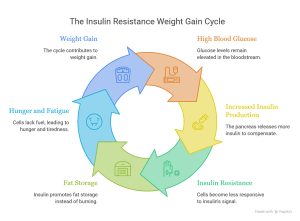
Insulin is the hormone that lets your cells pull glucose out of your blood and either burn it for energy or store it for later, some as glycogen and some as fat. It does one more thing people forget: while insulin is high, it puts the brakes on fat burning.
In type 2 diabetes, cells stop responding to that signal properly. Glucose struggles to get in, so it lingers in the bloodstream, and the pancreas responds by pumping out even more insulin. That’s what makes weight loss so stubborn. All that circulating insulin keeps your body in storage mode and blocks fat burning, while your cells, still short on usable fuel, leave you hungry and tired.
This is called insulin resistance, and it traps people with type 2 diabetes in a frustrating loop: high insulin, easy storage, hard loss. Add the fact that some diabetes medications cause weight gain, and it’s clear why generic diet plans often fall short. What you need is guidance built around how type 2 diabetes actually works.
The MELT Method
Simplifying weight management for people with diabetes in Ontario is the reason The MELT Method exists.
We understand the struggle of trying to lose weight with type 2 diabetes. We connect you to weight loss physicians and diabetes educators who provides proven medication options, lifestyle changes, dietary education, fitness plans, and behavioural counselling to get you on the right path. It’s when you get a personalized plan that the scale finally starts moving.
The best bit? The MELT Method offers fully OHIP-covered weight loss consultation , along with free delivery of your weight loss meds, discreetly packaged and delivered direct to your door anywhere in Ontario.
Hold On, Can My Own Medication Be The Problem?
Diabetes and weight gain often go hand in hand, and some of the most common medications can add to the problem. Weight gain is a known side effect of:
- Insulin and sulfonylureas (such as gliclazide and glyburide)
- Certain antidepressants and antipsychotics (such as mirtazapine, some SSRIs, olanzapine, and quetiapine)
- Beta-blockers, gabapentin, pregabalin, and long-term oral steroids
How Much Do You Actually Have To Lose?
Less than you’re dreading. Nobody’s asking you to get back to your high-school weight.
Diabetes Canada pegs losing about 5% to 10% of your current body weight as being better for insulin sensitivity, blood sugar, and blood pressure. On a 200-pound frame, that’s 10 to 20 pounds. Not 70. The American Diabetes Association’s 2026 standards say pretty much the same, landing around 5% to 7%.
What Changes After the First 5% to 10%
This is the most encouraging part of the journey, and it often happens faster than people expect, usually before the mirror catches up.
- Blood sugar and A1C: Fasting glucose often drops within weeks. A1C improves over the following three months, since it reflects roughly a three-month average. For many people, a 5% to 10% loss can reduce medication needs.
- Blood pressure: Often improves within the first month or two.
- Triglycerides and liver health: Triglycerides can fall quickly, and markers of fatty liver often improve, because visceral fat and liver fat tend to be among the first to go.
- Energy, joints, and sleep: Many people notice better energy, less joint pain, and better sleep within the first few weeks, often before any big change on the scale.
The bloodwork moves before the mirror does. That’s why it’s worth watching your labs and energy, not just the scale.
Bigger losses, held onto, can do something that still catches people off guard. The DiRECT trial pushed nearly half its participants into remission at one year. Remission as in normal blood sugar, off the diabetes meds. What mattered most was how much they lost and kept off, and it worked best early in the disease.
That’s what The MELT Method was built for; helping people lose weight with type 2 diabetes – the right way and to the right amount.
What’s Covered in Ontario (and What Isn’t)
This is where many Ontario patients get caught off guard. Because OHIP covers their doctor, they assume their weight loss medication is covered too. It usually isn’t.
- OHIP covers physician visits, not outpatient prescription drugs.
- Drug coverage runs through the Ontario Drug Benefit (ODB) program, which covers seniors, ODSP and Ontario Works recipients, and some others, or through private insurance.
- Ozempic is covered through ODB only under Limited Use criteria for adults with type 2 diabetes, not for weight loss alone.
- Wegovy is not publicly covered in Ontario. National price negotiations with the manufacturer ended in December 2025 without a deal, so it remains private-pay or dependent on private insurance.
For people without diabetes, GLP-1 therapy for weight management is, for now, mostly a private-pay or private-insurance question.
Where Ozempic And The GLP-1s Fit
You know the name already. Semaglutide and the rest of the GLP-1 receptor agonists shook up how the whole field thinks about weight loss with type 2 diabetes, because they go at blood sugar and weight together.
When specifically talking about Ontario, Ozempic is approved to treat type 2 diabetes and to lower cardiovascular risk in certain patients, but not for weight management, even though doctors prescribe it off-label for weight constantly. The product actually approved for weight is a separate, higher-dose version under the name ‘Wegovy’. Curious how one drug does both jobs? We get into the mechanics in our explainer on how GLP-1 medications work. Just know they do their best work when paired with exercise, nutrition and lifestyle habit modifications.
The good news? Generic Semaglutide just got approved by Health Canada and the prices have come way down.
Time for Some Myth-Busting
Myth 1: “Type 2 diabetes is permanent and only gets worse.”
This is the biggest piece of misinformation people with type 2 diabetes carry. Many have been told to manage it, never that meaningful weight loss can put it into remission. That belief quietly lowers everyone’s ambition.
A close second is the idea that people “did this to themselves.” That shame-based framing is both wrong and counterproductive.
Myth 2: “Remission means I’m cured.”
Remission means your blood sugar is back in the normal range and staying there without diabetes medication. By expert consensus, that’s an A1C below 6.5% sustained for at least three months off glucose-lowering drugs. It’s a genuine, life-changing milestone.
The reason we don’t call it a cure is that the underlying tendency is still there. If the weight comes back, the diabetes can come back – which is exactly why we keep monitoring even after someone is doing great. We frame it like this: remission isn’t the finish line – it’s a state you get to keep maintaining. And that’s good news, because it means it’s in your hands.
That framing protects motivation. Patients hear “I can get there and I can stay there,” not “I’m broken forever” and not “I’m cured, I can stop.”
Myth 3: “Just eat less and move more.”
It’s not false. Energy balance is real. But as advice, it’s close to useless for people with type 2 diabetes, and often harmful. It implies the only missing ingredient is effort, which puts blame on people who are already trying hard. And it ignores everything that actually needs treating: insulin resistance, medications, sleep, hormones, and a body that defends its old weight.
Most people have already “eaten less and moved more” many times. The honest version is that strategy matters more than effort, and the strategy needs to match your physiology.
What Good Care Looks Like Here
People trying to lose weight with insulin resistance usually have the target but not the roadmap. Done right, weight management for people with diabetes isn’t a juice cleanse or a handout from a ten-minute appointment. It’s medical oversight, a plan that works with the medications you already take, and someone tracking your numbers as they change. And they will change, sometimes enough that your doses can come down.
Money is the other quiet blocker. Plenty of patients assume it’s all out of pocket and never ask. Before you write it off, check this: some of that care falls under OHIP covered weight loss programs.
The Hard Part About Weight Loss Comes After Weight Loss
Losing weight is one thing. Keeping the weight from coming back is another ball game. This is where most plans quietly fall apart because keeping your weight down takes building healthy habits that feel like the ‘new normal’ rather than a goal to check off your bucket list.
When you drop weight, your body pushes back to get back to the same level. It burns a touch less cals, turns hunger up a notch, and waits for you to slip. Getting past that takes an actual plan, which is what we lay out in our piece on maintaining weight loss. With diabetes there’s a bonus: hold the loss steady and the blood sugar also starts to stabilize.
If you’re tired of watching weight loss transformation videos and feel like this is the year you’re going to take charge of your health and weight, get in touch with us. We connect you to weight loss physicians who may prescribe medication paired with guidance on how to lead a healthy lifestyle, exercise, and behavioral regimens to not only help you lose weight fast, but also help you build habits that keep you from gaining that weight back. The first and all consultations are free and 100% OHIP-covered. What excuse do you have now?
Frequently Asked Questions
1. Can losing weight reverse type 2 diabetes?
For some people, yes. Sustained weight loss has tipped type 2 diabetes into remission in trials, with the best odds in the first few years after diagnosis. Not a cure, and not everyone gets there. But blood sugar usually improves as the weight does.
2. What is the best diet for weight loss with type 2 diabetes?
The one you’ll still be following in six months. When researchers line the popular diets up against each other, the differences mostly wash out by the one-year mark. So pick something you can live with. Whole foods, more fibre, steadier carbs.
3. Which weight loss medications are safe for diabetics in Canada?
Several GLP-1 options are approved here. Whether one of them suits you comes down to your other conditions and medications, and that’s a call for your prescriber, not Google.
4. Does Ozempic help with weight loss in type 2 diabetes?
In the trials it did, alongside steadier blood sugar. How much depends on the person and the dose. It’s a prescription, used with medical supervision.
5. How much weight do you need to lose to improve blood sugar?
Often surprisingly little. A 5% to 10% drop is enough to shift insulin sensitivity and blood sugar for a lot of people.
6. Is the MELT Method suitable for people with diabetes?
Yes, and the medical oversight is the whole point. We build the plan around the treatment you’re already on. Start with a conversation about your goals and your current meds.