


TL;DR
- Yes, some muscle loss on GLP-1 medication is normal. In the STEP 1 trial, semaglutide (Ozempic) users lost 19.3% fat mass and 9.7% lean mass; in SURMOUNT-1, about 75% of tirzepatide (Mounjaro) users’ weight loss was fat and 25% was lean mass.
- Real-world data on roughly 8,000 patients shows tirzepatide users tend to lose somewhat more lean mass than semaglutide users over 12 months, but exercise and protein intake matter more than which drug you’re on.
- “Lean mass” isn’t the same as “muscle.” It includes water, organs, and connective tissue — a 2025 mouse study found most of the lean-mass drop came from the liver shrinking, not muscle.
- Protein (20–40g per meal) and resistance training (at least 2x/week) are the two levers proven to protect muscle while the medication handles fat loss.
- A structured, physician-led program, like The MELT Method’s OHIP-covered weight loss program, builds these protections into your plan instead of leaving you to figure it out alone.
This article is educational content, not medical advice. Talk to your prescribing physician or care team before changing your medication, diet, or exercise routine.
If you’re losing weight on Ozempic or Mounjaro, you’ve probably heard some version of the warning: “You’re not just losing fat, you’re losing muscle too.” It’s a real phenomenon, and it’s worth understanding. But it’s also more nuanced and more manageable than the headlines suggest.
In this blog we will learn what the clinical research actually shows about muscle loss on GLP-1 medication, why it happens, and the specific protein and training strategies that protect lean mass while you lose fat.
And, if you feel you need expert guidance on sustainable eating patterns, meal planning strategies, controlling stress-based eating and building healthy habits, including access to weight loss physicians who can prescribe proven weight loss drugs like Zepbound and Wegovy, then click the “Start Free Assessment” button below. At The MELT Method, registered dietitians are billed directly to insurance while we also connect you to weight management doctors across Ontario for OHIP-covered online consultations. Just fill out our quick, 2 minute assessment to get started.
What The Clinical Trials Actually Show
Both major GLP-1 medications have been studied in detail using DXA body composition scans, which measure exactly how much of a person’s weight loss comes from fat versus lean mass.
Semaglutide (Ozempic/Wegovy) — STEP 1 trial: Participants lost an average of 15.0% of their body weight, compared to 3.6% on placebo. Of that loss, fat mass dropped 19.3% (visceral fat dropped even more, at 27.4%), while lean mass dropped 9.7%. Importantly, lean mass as a share of total body weight actually went up by 3.0 percentage points, meaning body composition shifted in a favorable direction overall. The people who lost the most weight (15%+) saw the biggest improvement in their lean-to-fat mass ratio.
Tirzepatide (Mounjaro/Zepbound) — SURMOUNT-1 trial: Body composition sub-study data shows a similar pattern, with roughly 75% of total weight lost coming from fat mass and about 25% from lean mass.
Ozempic vs. Mounjaro, head to head: A 2026 real-world study using digital body-composition tracking on nearly 8,000 patients (6,196 on semaglutide, 1,769 on tirzepatide) found that tirzepatide users lost about 1.1% more lean mass than semaglutide users at three months, and that gap widened to roughly 2% by twelve months. About 10% of tirzepatide users hit both a 20%+ total weight loss and a 5%+ lean mass loss, compared to 7% of semaglutide users.
“Tirzepatide is generally more potent than semaglutide, and with greater overall weight loss, you often see a higher degree of lean mass loss,” explains Dr. Jeffrey Lee, a plastic surgeon who prescribes GLP-1 medications. But as Dr. Mir Ali, a bariatric surgeon, puts it: “Adequate protein intake and exercise are essential for preserving muscle” — regardless of which medication you’re on.
You may also see the claim that “up to 40% of GLP-1 weight loss is muscle” circulating online. That figure is higher than what the controlled trial data above actually shows (closer to a quarter to a third of total weight lost). It’s worth knowing the number exists, but the STEP 1 and SURMOUNT-1 figures are the more reliable ones to plan around.
If you’re curious about the mechanism behind why these medications work the way they do, we cover that in how do GLP-1 medications work.
“Lean Mass” Isn’t The Same Thing As “Muscle”
This is the detail that gets lost in most headlines. When a DXA scan reports “lean mass,” it’s measuring everything in your body that isn’t fat, muscle, yes, but also water, organs, and connective tissue. A meaningful chunk of “lean mass loss” isn’t muscle fiber disappearing at all.
One study found a 10.9% reduction in lean mass alongside a 33.9% reduction in fat mass, and researchers note that some of that lean-mass drop is water and structural tissue that gets released as fat cells shrink, not actual muscle being broken down.
A 2025 mouse study from the University of Utah, published in Cell Metabolism, adds an interesting wrinkle. Researchers found that semaglutide-induced weight loss reduced overall lean mass by about 10%, but only around 6% of skeletal muscle mass shrank on average. The biggest driver of lean-mass loss was actually the liver, which shrank by nearly 50%, an expected, healthy change as a metabolically active organ carries less fat.
Interestingly, the same study found that some muscles lost strength even when they didn’t shrink in size, a “strength paradox” researchers can’t fully explain yet. As senior author Dr. Katsu Funai put it: “We have data in mice that suggest that things are not as straightforward as they might seem… If we want to really help the individuals who may be losing muscle mass, then we need to know that they’re actually losing muscle mass.” Co-author Dr. Ran Hee Choi added: “Loss of mass in metabolically active organs, such as the liver, is expected as part of healthy weight loss.”
The researchers are clear that this is mouse data and human trials are still needed, but it’s a useful reminder that “you’re losing muscle” and “you’re losing lean mass” aren’t automatically the same statement.
Why Muscle Loss Happens On Glp-1 Medications
Two mechanisms explain most of the muscle loss seen on Ozempic and Mounjaro:
- Reduced protein and calorie intake. These medications work by suppressing appetite, which is the point, but it also means many patients unintentionally eat less protein than their body needs to hold onto muscle during weight loss.
- Reduced physical activity. Lower appetite often comes with lower energy, which can mean less daily movement. Without a resistance-training stimulus, the body has less reason to preserve muscle it isn’t using.
The risk is higher for people on higher doses, longer treatment duration, with limited exercise tolerance, or with pre-existing musculoskeletal conditions.
How To Protect Muscle While Losing Fat On Ozempic Or Mounjaro
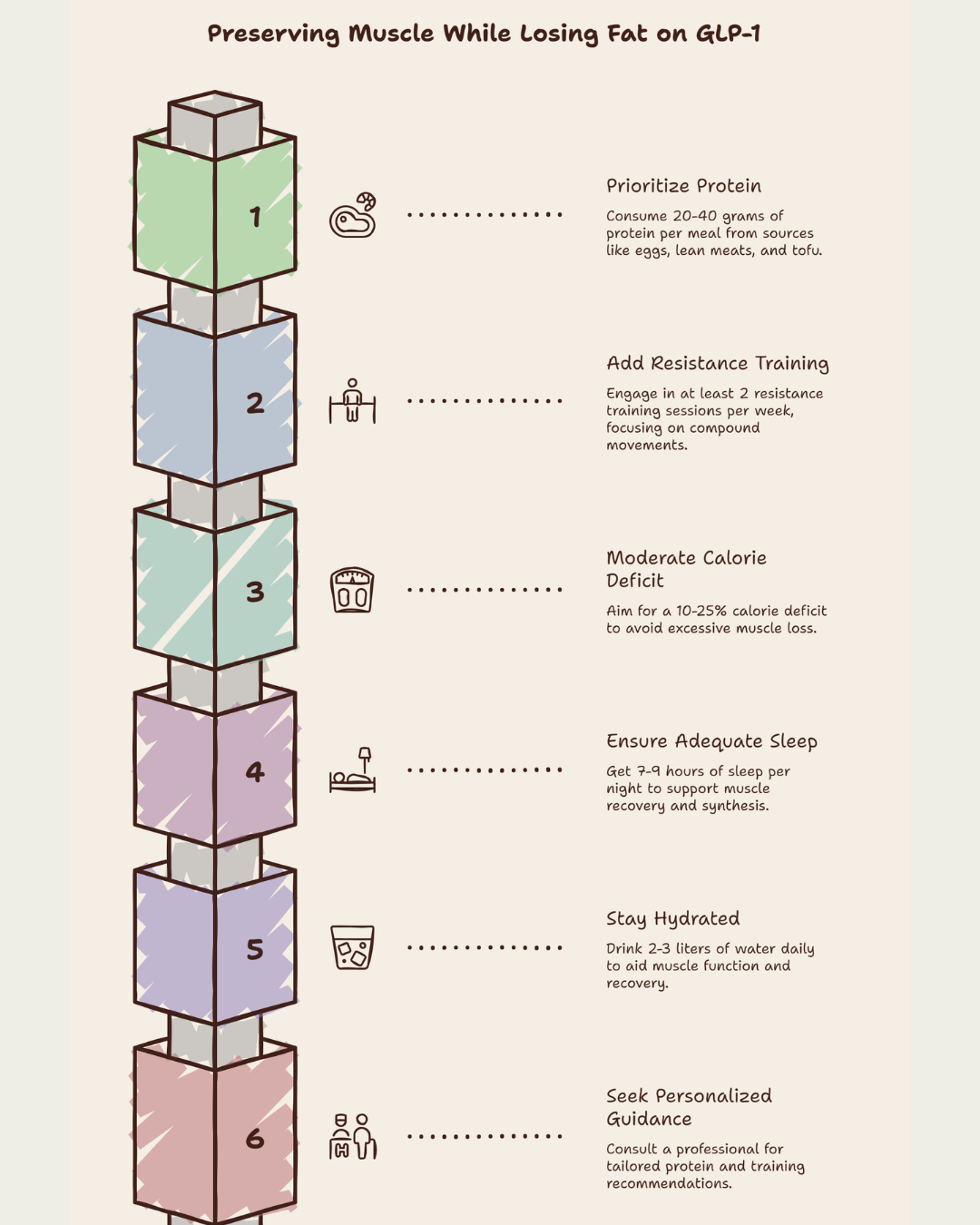
The good news: the two things that protect lean mass on GLP-1 medication are well established and entirely within your control.
1. Prioritize protein intake
The standard baseline (0.8g of protein per kg of body weight per day) is a minimum, not an optimal target during active weight loss and adults over 65 typically need more. A practical, GLP-1-specific target is 20–40 grams of protein per main meal, spread across the day rather than loaded into one sitting.
Good sources to build meals around: eggs, lean meats and poultry, fish, low-fat dairy, tofu, and legumes.
One caveat worth remembering: protein alone isn’t enough. Without a resistance-training stimulus, extra protein has less to “build toward.” Which brings us to the second lever.
2. Add resistance training
U.S. physical activity guidelines recommend muscle-strengthening activity at least 2 days per week, in addition to aerobic exercise. GLP-1-specific guidance echoes this: at least 2 resistance training sessions per week, focused on compound movements that work multiple muscle groups like squats, presses, rows, and hip-hinge patterns.
If energy or exercise tolerance is limited, accessible entry points include bodyweight squats, push-ups, resistance bands, calf raises, and machine-based exercises at a gym. The goal is consistency, not intensity, especially in the first few weeks.
For a broader look at how much activity supports weight loss generally (not just muscle preservation), see how much exercise to lose weight.
3. Support the basics
A few supporting factors round out the picture:
- Moderate the deficit. Aim for a 10–25% calorie deficit and a loss rate of roughly 0.5–2 lbs per week rather than an aggressive cut, which raises the risk of losing muscle along with fat.
- Sleep 7–9 hours per night. Sleep supports muscle protein synthesis and recovery from resistance training.
- Stay hydrated. Roughly 2–3 litres per day (8–12 cups), adjusted to your individual needs.
- Get personalized guidance. Protein and training needs vary by age, activity level, and starting point, working with a professional takes the guesswork out of it. Learn more about what does a registered dietitian do to support a GLP-1 treatment plan.
Who’s Most At Risk
Muscle loss risk on GLP-1 medication tends to be higher for:
- Older adults, where preserving physical function is especially important for long-term quality of life
- Patients on higher doses or longer treatment durations
- People with low baseline physical activity
- Anyone with pre-existing musculoskeletal conditions that limit exercise
If you fall into one or more of these categories, it’s worth flagging muscle preservation as a priority with your care team from day one, not something to address after the fact.
Why This Is Easier With A Structured Program
Knowing that protein and resistance training protect muscle is one thing. Building both into a realistic weekly routine, while also managing medication, appetite changes, and everyday life is another.
This is where a cohesive approach makes a measurable difference. At The MELT Method, we connect you to accredited weight loss physicians, who might prescribe proven weight-loss medication, like Zepbound and Wegovy, based on your unique health profile. The medication is paired with personalized fitness, nutrition, and mindset coaching from our own, in-house team of specialists. We also offer direct bill to insurance for diet and behavioral coaching, while OHIP covers your consultation with weight management physicians, and we don’t charge a dime for connecting you with them.
What we mean to say is this: If you get in touch with us, your customized plan will likely include GLP-1 medications, exercise, diet and behavioral plans, protein targets and training frequency, and will be adjusted as you go. This is what The Melt Method’s OHIP-covered weight loss program offers: guided, scientific support for weight loss, available for all Ontarians via online consultations, mostly covered by OHIP or billed directly to insurance.
If you’re currently on, or considering Ozempic or Mounjaro and want a plan that protects lean mass while you lose fat, a free assessment with our weight loss clinic is a no-cost, no-commitment place to start. Just start with a free, 2 minute assessment now.
Frequently Asked Questions
1. Is it true that GLP-1 medications can cause muscle loss along with fat loss?
Yes. Clinical trial data confirms it: in the STEP 1 trial, semaglutide (Ozempic) users lost 9.7% lean mass alongside 19.3% fat mass. In SURMOUNT-1, about 25% of tirzepatide (Mounjaro) users’ total weight loss was lean mass, versus 75% fat mass. Some muscle loss is a normal part of any significant weight loss, medication-assisted or not, the goal is to minimize it, not eliminate it entirely.
2. How much protein should I eat daily while taking Ozempic or Mounjaro?
A practical target used in GLP-1-specific guidance is 20–40 grams of protein per main meal, spread across the day. This is higher than the standard baseline of 0.8g per kg of body weight per day, which is considered a minimum rather than an optimal amount during active weight loss, especially for adults over 65. A registered dietitian can help set a precise target based on your weight, age, and activity level.
3. Does strength training prevent muscle loss during medically supervised weight loss?
Resistance training is one of the two most effective, evidence-backed strategies for preserving lean mass during GLP-1 treatment (alongside adequate protein). Guidance suggests at least 2 resistance training sessions per week focused on compound movements like squats, presses, and rows. Protein intake alone, without resistance training, is unlikely to be enough to fully protect muscle.
4. Can losing muscle slow down my metabolism long-term?
Muscle tissue is metabolically active, so losing a significant amount of it can lower resting metabolic rate over time, which can make long-term weight maintenance harder. This is exactly why protecting lean mass during treatment, through protein and resistance training, matters beyond just how you look on the scale; it affects your metabolic health well after you reach your goal weight.
5. Should I be worried about muscle loss if I’m following a structured program?
Not typically to the point of worry, but it’s still worth actively addressing. Trial data shows that even with medication working as intended, some lean mass loss occurs, a structured program with built-in nutrition and resistance-training support (rather than medication alone) is specifically designed to keep that loss to a minimum and monitor your progress along the way.
6. What are the signs I might be losing muscle instead of just fat?
Watch for noticeably decreased strength (lifting less than before, or trouble with everyday tasks like stairs or carrying groceries), increased fatigue, or a “smaller but softer” appearance rather than a leaner one. Because scale weight alone can’t distinguish fat loss from muscle loss, a body composition assessment (such as a DXA scan or bioelectrical impedance analysis) with your care team gives a much clearer picture than weight alone.
7. How does a physician-led program help protect lean mass during treatment?
A physician-led program builds protein targets, resistance training, and progress monitoring directly into your treatment plan from the start, rather than leaving muscle preservation as an afterthought. It also allows for adjustments, to dose, diet, or activity level, based on how your body composition is actually changing, not just what the scale says. That combination of medication plus coaching is the core of how MELT Method’s program is structured.