

TL;DR
- Stress and weight gain are biologically linked, not just a willpower issue. Chronic stress keeps cortisol elevated, and visceral (belly) fat has roughly 4x more cortisol receptors than fat elsewhere, which is why stress-driven weight gain tends to collect around the middle.
- Cortisol also drives insulin resistance, increases appetite via neuropeptide Y, and can slow metabolism, so it’s possible to gain weight from stress even while eating reasonably well.
- Emotional eating isn’t just “cravings winning.” A Harvard-affiliated brain-imaging study found emotional eaters show reduced activity in reward-processing brain regions under stress, eating becomes an attempt to self-correct that dip, not simply chasing pleasure.
- A 2026 study of 252 adults found food cravings explain roughly 19–20% of the link between psychological distress (stress, anxiety, depression) and BMI.
- What actually works, per the evidence: mindfulness meditation (shown to meaningfully cut craving scores in a controlled trial) and cognitive behavioral therapy (shown to significantly reduce emotional eating), alongside the basics: sleep, resistance training, and a protein-and-fiber-forward diet.
- A physician-led program that includes mindset coaching, like MELT Method’s OHIP-covered weight loss program — addresses the psychological side of this cycle, not just the food side.
This article is educational content, not medical advice. If emotional eating or stress feels significant or distressing, talk to your care team or a mental health professional.
If you’ve ever wondered why a stressful week shows up on the weight scale, and specifically around your middle, the answer isn’t a lack of discipline. It’s a well-documented biological loop: stress raises cortisol, cortisol promotes fat storage and hunger, and the resulting cravings trigger eating that offers real, if temporary, relief. That relief is exactly what makes the cycle so hard to break on willpower alone.
Here’s what the research actually shows about the connection between stress and weight gain, why emotional eating happens at a brain-chemistry level, and the specific strategies with evidence behind them.
And, if you feel you often get stuck in this stress-emotional eating loop, speaking with a behavioral coach will be extremely helpful. At The MELT Method, behavioral coaching is billed directly to insurance while we connect you to weight management doctors across Ontario for OHIP-covered consultations. Just fill out our quick, 2 minute assessment to get started.
The Cycle, In Plain Terms
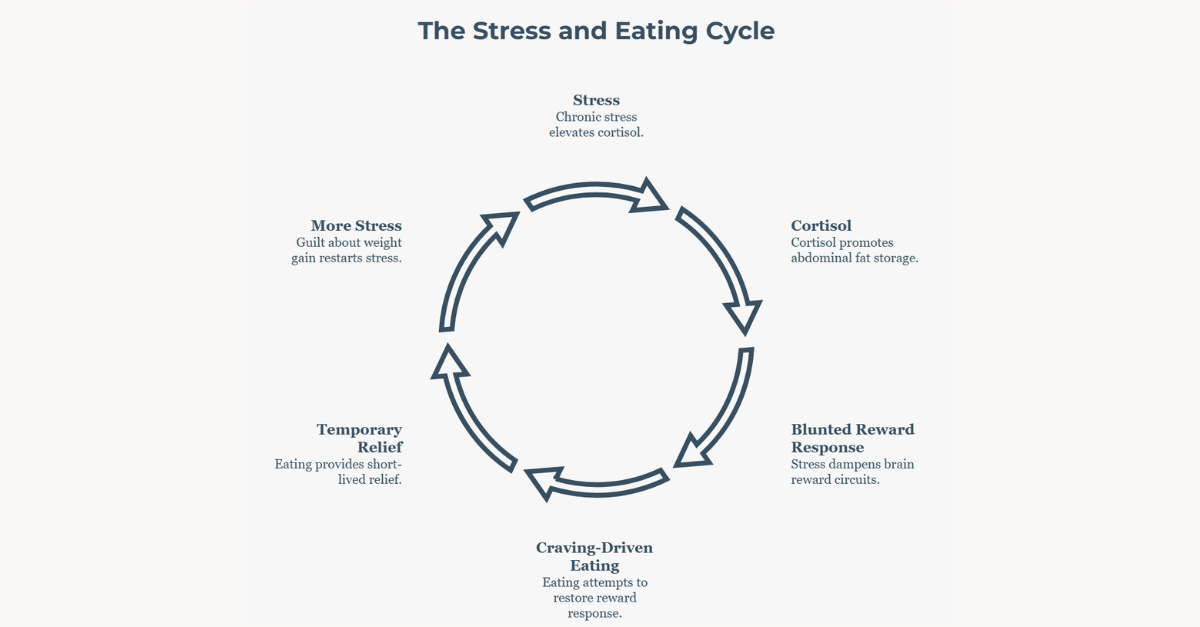
It runs in both directions at once:
- Stress → cortisol → abdominal fat storage. Chronic stress keeps cortisol elevated, and cortisol specifically promotes fat storage around your midsection.
- Stress → blunted reward response → craving-driven eating. Stress dampens activity in the brain’s reward circuits, and eating becomes a way of trying to restore that response — which feels like a craving, but is really a compensation mechanism.
- Eating → temporary relief → more stress (often about the weight gain itself). The relief is real but short-lived, and for many people, guilt or frustration about weight gain becomes its own stressor, which restarts the cycle.
Understanding both halves, the physical and the psychological, is what makes it possible to actually interrupt the loop, rather than just white-knuckling through cravings.
The Physiology: How Cortisol Builds “Stress Belly”
Cortisol is your primary stress hormone, released via the hypothalamic-pituitary-adrenal (HPA) axis. When stress is short-lived, cortisol does its job and settles back down. When stress is chronic, cortisol stays elevated and that has several measurable effects on body composition:
- Cortisol belly fat is a real, distinct pattern. Research on visceral fat and cortisol receptors shows that visceral fat around your abdominal organs has roughly 4 times more glucocorticoid (cortisol) receptors than subcutaneous fat elsewhere on the body, making it disproportionately responsive to cortisol signaling. This is why stress-related weight gain tends to concentrate at the waist rather than distributing evenly.
- Insulin resistance. Elevated cortisol impairs insulin signaling, which can promote abdominal fat storage even during a calorie deficit.
- Appetite dysregulation. Cortisol increases appetite by stimulating neuropeptide Y (a key hunger-signaling neuropeptide) while also blunting normal fullness cues.
- Metabolic suppression. Prolonged cortisol elevation can reduce the conversion of thyroid hormone into its active form, which can lower resting metabolic rate.
- An inflammatory feedback loop. Visceral fat itself releases inflammatory signals that can further perpetuate the stress-cortisol cycle, meaning stress-driven fat gain can make your body more reactive to future stress, not less.
This is the mechanism behind a common, frustrating experience: doing “everything right” with food and still seeing weight gain, or a stubborn midsection, during a high-stress period.
The Psychology: Why Cravings Hit Harder Under Stress
The behavioral half of this cycle has a genuinely interesting explanation and it’s not the one most people assume.
A Harvard-affiliated study led by Dr. Laura Holsen, Associate Professor of Psychiatry at Brigham and Women’s Hospital, used brain imaging and stress testing on 28 adults to understand why some people eat more under stress and others don’t. The finding: emotional eaters didn’t show heightened reward-region activity when anticipating food under stress, they showed reduced activation in reward-processing areas of the brain (including the nucleus accumbens), alongside significantly elevated anxiety and cortisol. The more anxious someone felt, the lower their reward-region activity.
The researchers’ interpretation: this dip in reward-circuit activity may prompt compensatory eating as the brain’s attempt to restore normal reward processing, in other words, emotional eating isn’t chasing extra pleasure from food. It’s an attempt to correct a temporary shortfall.
That reframe matters. It also lines up with population-level data: a 2026 study of 252 adults found that food cravings mediated roughly 19–20% of the relationship between psychological distress (stress, anxiety, and depression, tested separately) and BMI, a measurable, quantifiable link between how distressed someone feels and how much their weight is affected through cravings specifically.
Emotional Hunger vs. Physical Hunger
One practical distinction worth building into daily awareness: emotional hunger tends to come on suddenly, craves a specific comfort food (rather than “food in general”), doesn’t respond to fullness the way physical hunger does, and is often followed by guilt. Physical hunger builds gradually, is open to a range of foods, stops when you’re full, and doesn’t carry an emotional aftertaste. Neither the Harvard study nor the 2026 mediation study frames this as a moral distinction, it’s simply a signal-detection skill that mindfulness-based approaches (below) are specifically designed to strengthen.
Breaking the Cycle: What the Evidence Actually Supports
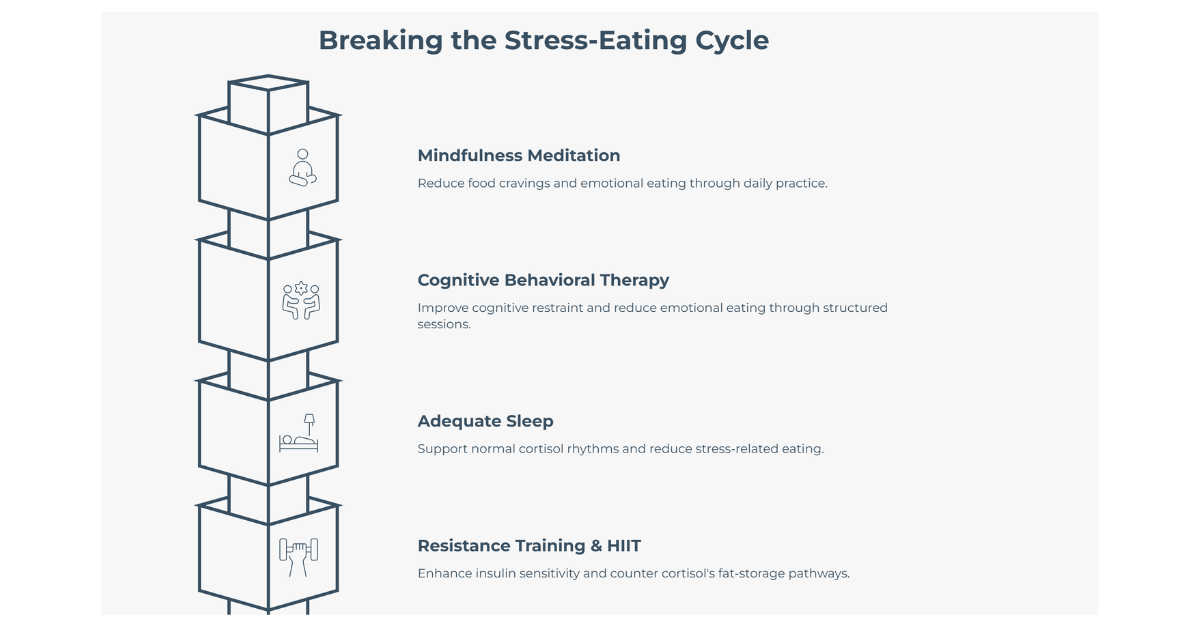
Mindfulness meditation
A 2024 randomized controlled trial published in Nature Scientific Reports tested a 31-day web-based mindfulness meditation program (15 minutes a day) against a health-education control group, in 66 adults with stress-eating tendencies. Using behavioral assessments and brain scans before and after:
- Food-craving scores dropped from 84.0 to 55.6 in the mindfulness group, a statistically significant change (p < 0.001), with no significant change in the control group.
- Stress-eating and emotional-eating scores both dropped meaningfully, alongside measurable increases in mindfulness awareness.
- These behavioral changes correlated with brain connectivity changes in regions controlling appetite, reward, and emotional regulation.
A smaller pilot study similarly found that a 6-week mindfulness-based emotional eating program, deliberately not framed around weight loss, produced significant improvements in food-cue reactivity, intuitive eating, and stress levels.
Cognitive behavioral therapy (CBT)
A meta-analysis of 12 randomized controlled trials (n = 6,805) on cognitive behavioral therapy for weight loss found that CBT produced a modest weight-loss advantage over comparison interventions, and, more relevant here, significantly reduced emotional eating and substantially improved cognitive restraint (the ability to consciously regulate eating rather than react to cravings). Source: PubMed meta-analysis.
The physiological basics
Because stress eating has a hormonal component, not just a psychological one, these fundamentals directly target the cortisol side of the cycle:
- Sleep 7–9 hours per night. Sleep supports a normal cortisol circadian rhythm; poor sleep keeps cortisol elevated the following day, compounding the cycle.
- Resistance training and HIIT. Both specifically improve insulin sensitivity, directly countering one of cortisol’s main fat-storage pathways.
- Prioritize protein and fiber; minimize refined carbohydrates. This supports steadier blood sugar and satiety, reducing the appetite swings cortisol creates.
- Practice a stress-response “off switch.” Mindfulness meditation and slow, deep breathing activate the parasympathetic nervous system, directly counteracting HPA-axis activation.
Expect this combination to take roughly 2–3 months to produce visible change, a useful expectation to set going in, since the cycle didn’t form overnight and won’t unwind overnight either.
If you want a deeper look at the psychological side of this, beyond stress specifically, see psychology of weight loss.
Why This Needs More Than a Diet Plan
Here’s the practical problem with most weight-loss advice: it addresses the food side of this cycle (what and how much to eat) but not the stress side (why cravings show up in the first place) or the physiology side (what’s actually happening with cortisol and insulin). Since stress-driven weight gain runs on both a hormonal and a psychological track simultaneously, a plan that only changes what’s on your plate is working against half the mechanism.
This is exactly why mindset coaching is a core part of MELT Method’s program, alongside medication and nutrition guidance not an add-on. Addressing the stress-and-cravings side of weight management directly is part of what supports weight being kept off long-term; see maintaining weight loss for more on that piece specifically.
If you’re noticing that stress, more than diet alone, seems to be driving your weight, an OHIP-covered weight loss assessment through our OHIP-covered weight loss program is a no-cost, no-commitment way to get a plan that addresses both sides of the cycle. We have behavioral therapists, lifestyle coaches, exercise experts who can create a tailored plan for you and supplement it further by connecting you with weight loss physicians across Ontario for OHIP-covered, online consultations. Just complete a 2 min, free assessment to get started.
Frequently Asked Questions
1. Can chronic stress really cause weight gain even with a healthy diet?
Yes. Chronic stress keeps cortisol elevated, and cortisol independently promotes insulin resistance, increased appetite, and abdominal fat storage, sometimes even during a calorie deficit. It’s entirely possible to eat well and still see stress-related weight gain because the mechanism is hormonal, not purely about food choices.
2. What is cortisol belly fat and how is it different from regular fat storage?
“Cortisol belly fat” refers to visceral fat that accumulates around abdominal organs in response to chronically elevated cortisol. Visceral fat has roughly 4 times more cortisol (glucocorticoid) receptors than subcutaneous fat elsewhere on the body, making it disproportionately responsive to stress hormone signaling. That’s why stress-driven weight gain tends to concentrate at the waist rather than spreading evenly.
3. How do I tell the difference between emotional hunger and physical hunger?
Emotional hunger tends to come on suddenly, targets a specific comfort food, doesn’t ease with fullness the way physical hunger does, and is often followed by guilt. Physical hunger builds gradually, is open to a range of foods, and resolves once you’re full. Mindfulness-based approaches are specifically shown to strengthen the ability to notice this difference in the moment.
4. Can lowering cortisol levels help with weight loss?
Yes, because cortisol directly drives insulin resistance, appetite increases, and abdominal fat storage, reducing chronic cortisol elevation removes one of the underlying mechanisms working against weight loss. Sleep, resistance training, and mindfulness-based stress reduction are the most evidence-supported ways to do this, typically showing measurable effects within about 2–3 months.
5. What are practical ways to stop stress eating at the moment?
Evidence-based approaches include a brief mindfulness or breathing practice to interrupt the stress response before eating, pausing to identify whether the hunger is emotional or physical using the signals above, and having a planned alternative response (a short walk, a text to a friend) ready before the craving hits. Controlled trials have shown that even a daily 15-minute mindfulness practice can meaningfully reduce food-craving intensity over about a month.
6. Does poor sleep make cortisol-related weight gain worse?
Yes. Sleep is when cortisol’s natural circadian rhythm resets; insufficient sleep keeps cortisol elevated into the next day, which compounds the appetite and fat-storage effects described above. Aiming for 7–9 hours per night is one of the more direct, low-effort levers for interrupting the stress-weight cycle.
7. Can a physician-led weight loss program address stress eating, not just diet?
Yes, that’s the specific gap a program combining medical care with mindset coaching is designed to close. Because stress-driven weight gain has both a hormonal and psychological mechanism, addressing only food intake leaves half the cycle untouched. A physician-led program can monitor the physical side (weight, metabolic markers) while coaching addresses the emotional-eating patterns and stress-response habits driving cravings in the first place.